About the Census
The Curtis Census is a comprehensive and fully documented study of the publication, sales, and ultimate fates of the various sets of Edward S. Curtis's The North American Indian.
The goal of our work is to answer two basic questions:
-
How many sets of The North American Indian were originally published?
-
How many sets of The North American Indian still exist today?
We explore these questions and include a detailed record for each known set. We also discuss the history of the publication, the provenance and characteristics of identified sets, significant names associated with the publication, auction houses, bookshops, and art galleries that have sold various volumes of the books, and indices of the institutional and geographic locations of all sets we have documented.
Most references to the number of originally published sets of The North American Indian rely on Curtis’s original goal (500, revised to 300 in 1922) and a historical list commonly known as the Lauriat List. The latter is a tally of sets compiled when the Charles Lauriat Book Company acquired the entire remaining inventory of The North American Indian in 1935.
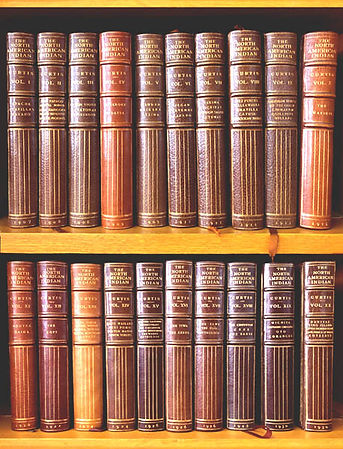
A review of the literature to date reveals this information has been largely surmised over the years based on Curtis’s original plan and the Lauriat list. We have compared that list with other historical documents that list the sets and subscribers by set number, and we discovered another list in the archives of the Autry Museum of the American West. That list was composed by Frederick Webb Hodge, Ethnologist-in-Charge at the U.S. Bureau of American Ethnology and the editor of the entire book series, from 1908. We found many inconsistencies across the lists we have compared.
As might be expected with any project that spanned three decades, the original record-keeping for The North American Indian was sometimes rigorous, sometimes lax, and, unfortunately, sometimes missing altogether. We have attempted to overcome these obstacles by locating and assembling detailed records of nearly 1,000 documents from around the world. By combining these with hundreds of hours of in-person visits, interviews, telephone calls, and emails, we believe we have created the most detailed record of the creation, publication, and distribution of Curtis’s monumental work.
Our work, at its core, is comprised of records of every set we have been able to document, as well as those we believe were never published and whose existence cannot be confirmed. We also identify all sets that have been broken apart through auctions and sales, those whose location we cannot determine, and those that have been destroyed. The study incorporates both internationally and domestically held sets. All 500 set numbers are accounted for in this census, although many of those were never used.
The Census is the work of a team of highly knowledgeable and very dedicated volunteers. Each person has contributed more than a thousand hours of research online and through in-person reviews of dozens of sets of The North American Indian. Here is our team:
Tim Greyhavens, a Seattle author, historical researcher, and photographer, began this project in November 2017. He shares the work of this census with two other editors, Judith Hayner and Janet Steins, who both joined the project in 2018. Greyhavens has most recently published the first comprehensive exploration of nineteenth-century photography in Washington State, Artistic and Life-Like: Photography in Washington, 1850-1900. He regularly writes essays about Curtis and other early photographers for scholarly publications and social media.
Judith Hayner is the former Executive Director of the Muskegon Museum of Art in Michigan. Hackley Public Library, located next door to the Muskegon Museum of Art, was built in 1888 and began a subscription to Curtis’s The North American Indian in 1908 (Set 70), making it one of the earliest subscribers. In 2014, this set, Set 70, was gifted to the Muskegon Museum of Art. In honor of that history and gift, in 2017, the museum exhibited all 723 photogravures from the portfolios of set 70 of The North American Indian, which was the first time all photogravures and volumes were exhibited at the same time.
Janet Steins is the former Collections Librarian of the Tozzer Library at Harvard University. Founded in 1866 as the Library of the Peabody Museum of Archaeology and Ethnology, it is the oldest library in the United States specializing in all subfields of anthropology, ethnology, and archaeology. The Tozzer Library holds the complete Set 44 of The North American Indian. Janet has a wealth of bibliographic and archival management knowledge, which has been especially useful to the census project as we research the provenance of each known set.